


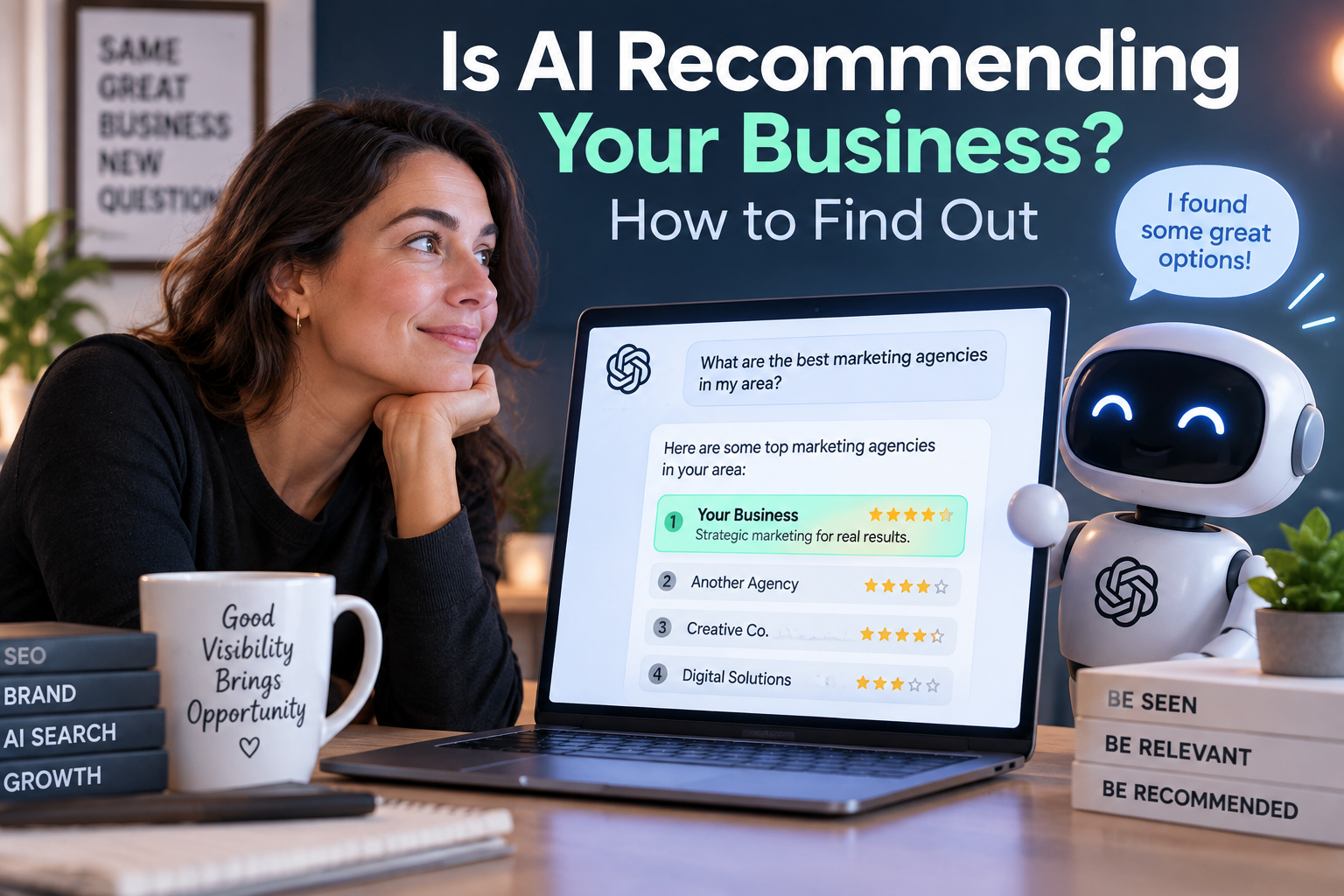
Think about the last time you needed a quick recommendation.
Maybe your AC stopped working in the middle of July. Maybe your kid needed a dentist. A few years ago, you probably would have Googled it, skimmed a few websites, compared reviews and maybe asked a neighbor for a second opinion.
Now, more and more people are skipping that whole process.
They're asking an AI tool the same way they'd ask a trusted friend. “Who should I call?” “Which one is reliable?” “Who won't overcharge me?” “What's the best option near me?”
When the answer comes back, many of them don't keep looking. They call the name they were given.
Search isn't just about showing up on Google anymore
For years, a solid website and a strong Google Business Profile did the heavy lifting. Someone searched “plumber near me” or “accountant in Celina,” got a page of blue links and started comparing. Your job was to climb that list and stay there. From there, your site carried the visitor toward a phone call or a booking.
That faucet is shutting off, and it isn't giving much warning.
The goal has shifted. It's no longer just about ranking on a results page. It's about being the business the AI names when someone asks.
The numbers behind the shift
This isn't a prediction. It's already measurable.
Between January and April of 2026, 68% of Google searches ended without a single click to any website, according to SparkToro's analysis of Similarweb clickstream data. In 2024, that number was 60%. The answer at the top of the page is resolving the question before anyone reaches a website.
On the business-to-business side, the shift is even sharper. In a Semrush survey of 622 U.S. B2B professionals conducted in March and April of 2026, 66% said they regularly use AI to research vendors and solutions — and 92% said AI has already shaped their vendor shortlist.
Read that last one again. For most buyers, the short list is getting built before anyone picks up a phone.
Why this matters more for businesses here
In Northwest Ohio and Northeast Indiana, a lot of good businesses have been carried for years by reputation and word of mouth. That's a real asset, and it isn't going away.
But word of mouth has a new middleman.
When someone new moves into the area, or a buyer at a plant in Fort Wayne needs a supplier, or an office manager in Lima needs a vendor by Friday, the “ask around” step increasingly happens inside a chat window. If your business has served this region well for thirty years but has almost nothing verifiable online, the AI has nothing to work with. It will name somebody else.
That's the uncomfortable part. You can have the better reputation locally and still lose the introduction.
AI doesn't rank you the way Google did
Here's what catches people off guard: AI tools don't always recommend businesses in the same order Google ranks them.
Businesses that never cracked page one are getting named by AI anyway, while page-one veterans get skipped. The tools are weighing things like specific, verifiable proof — case studies with real numbers, reviews with full names attached, press mentions, awards, industry credentials.
And most people don't double-check what the AI tells them. They go with it.
Four things you can do this month
1. Run the friend test. Ask someone outside your company to open ChatGPT and ask for the best business in your category near your town. Don't do it from your own account, where past history can skew the answer. See whether your name shows up. If it doesn't, treat that as useful information rather than bad news.
2. Take an honest inventory of your proof. Case studies with actual numbers. Reviews with full names. Awards. Certifications. Press mentions. Anything specific and verifiable. If that list is short, you don't have a marketing problem — you have a credibility gap, and those are two different repairs.
3. Publish one real piece of proof. Not a rebrand. One thing. A short customer story, a genuine push for reviews from clients who already love you, or a piece written in your own voice about something you actually know. Then publish it where it can be found.
4. Don't abandon what already works. Partnerships, local events, direct mail followed by a phone call, referral programs, showing up at the chamber. These still move faster than anything online for businesses in small markets. The point isn't to trade one for the other.
Where we fit, and where we don't
We should be straight with you: Tomorrow's Technology Today is not a marketing agency. We're not going to sell you an SEO package.
We're bringing this up because we watch technology shift underneath business owners for a living, and this one is moving quickly and quietly. The businesses that adjust early tend to spend a lot less fixing it later. That pattern is the same whether we're talking about search, security or a server nobody has patched since 2021.
What we do help with is the other half of this conversation — how AI tools are showing up inside your business, who's using them, what data is going into them and what your team should and shouldn't be putting in a chat window. That part is squarely ours, and most businesses we talk to have no policy around it at all.
If you want to talk through where AI fits in your business, and where it creates risk you haven't accounted for, we offer 10-minute discovery calls for exactly that kind of conversation.
Call us at (419) 678-2083 or visit www.TomTechToday.com/DiscoveryCall to schedule your call.
This article appears in the September 2026 issue of Technology Times. Read the full issue →