


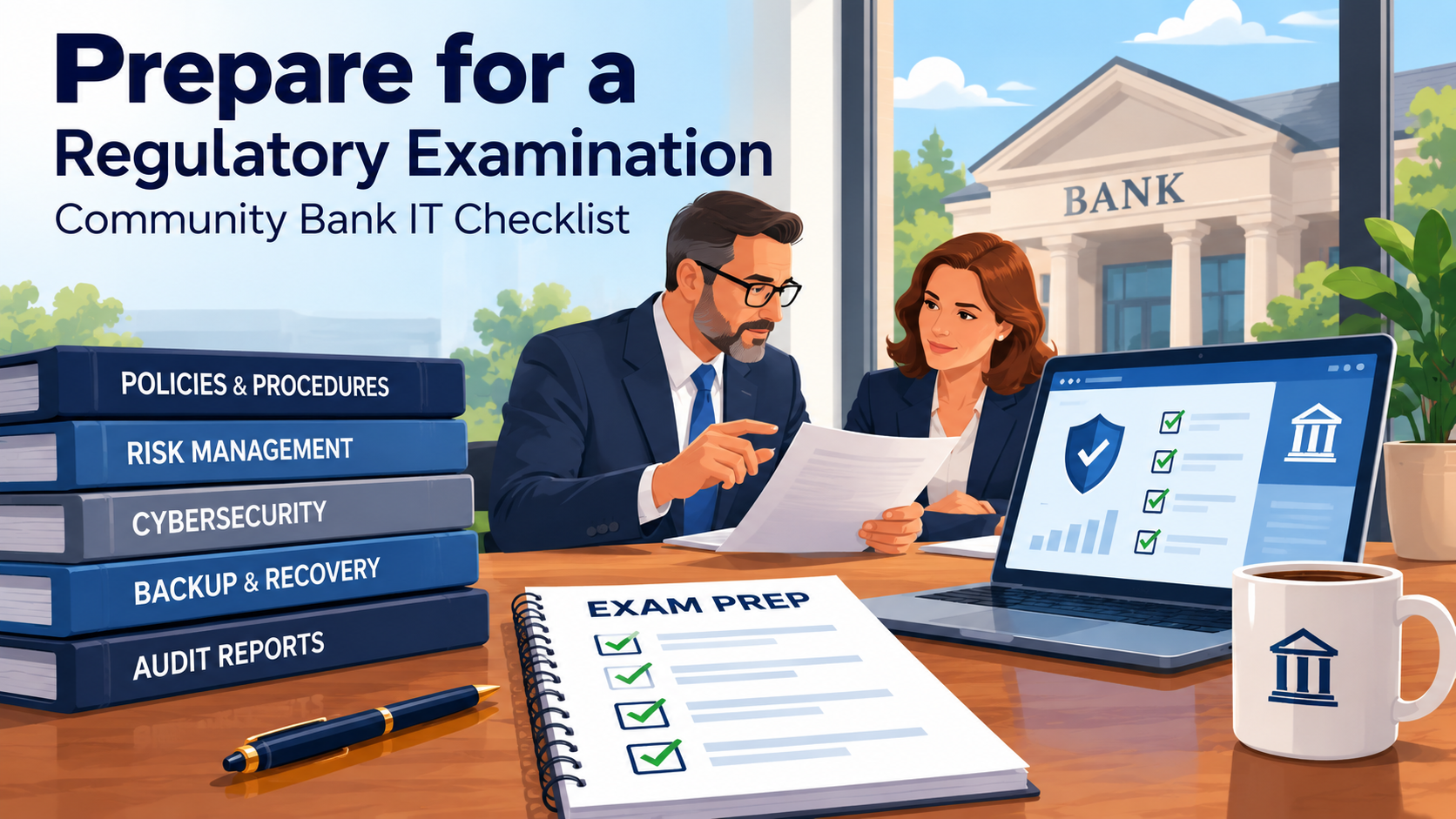
A community bank prepares its IT environment for a regulatory examination by maintaining IT and security evidence all year — vulnerability management, backup reporting, remote-session documentation, and monthly compliance reporting — so the exam doesn't trigger a scramble to reconstruct it.
A community bank shouldn't need months of last-minute IT preparation when a regulatory examination is approaching. While examinations may be scheduled months in advance, our community-bank clients typically give Tomorrow's Technology Today about one week's notice so our team knows the examination is approaching and can be available if needed.
Why only a week?
Because the real preparation has already been happening throughout the year.
Since 2011, we've worked with community banks to develop planned reporting and recurring documentation cadences that help maintain an ongoing portfolio of IT and security evidence. Every bank's regulatory requirements and examination scope can differ, but the underlying principle remains the same:
Document the work as it happens instead of trying to reconstruct months of evidence when examiners arrive.
1. Understand What Your Bank Needs to Document
There isn't one universal examination checklist that applies identically to every community bank.
A bank's examination depends on factors including its regulator, risk profile, operations, technology environment, and the scope of the examination.
Depending on the institution, federal supervision may involve the FDIC, Federal Reserve, or OCC. In Ohio, state-chartered banks are supervised by the Ohio Division of Financial Institutions, and state member banks by the Federal Reserve Bank of Cleveland. In Indiana, state-chartered banks are supervised by the Indiana Department of Financial Institutions, and state member banks by the Federal Reserve Bank of Chicago or St. Louis, depending on the bank's location. The Federal Financial Institutions Examination Council (FFIEC) also develops interagency principles, standards, handbooks, and examination procedures used across the regulatory environment.
Examiners aren't the only ones asking for IT evidence. Independent CPA firms, internal audit teams, and specialized IT and cybersecurity audits also review how the bank's technology is secured and documented — often at different times of the year. That's exactly why IT evidence should be maintained continuously rather than assembled for a single event.
That means an MSP shouldn't walk into every community bank with exactly the same compliance checklist.
Instead, the bank and its technology provider should identify the recurring IT and security evidence appropriate for that institution.
From our experience, a common backbone can include areas such as:
- Vulnerability management
- Backup reporting
- Remote-session documentation
- Monthly compliance reporting
The objective isn't to generate reports just because a technology platform has a report button.
The objective is to maintain useful evidence showing what is being monitored, managed, reviewed, and addressed. See Compliance Gaps Costing You Thousands for where this kind of evidence most often falls through the cracks.
2. Put Recurring Reports on a Planned Cadence
Once the bank determines what evidence it needs, that documentation should be placed on a recurring schedule.
This is where regulatory-examination preparation becomes an ongoing process rather than a last-minute project.
Vulnerability management shouldn't suddenly become important because examiners are coming.
Backup activity shouldn't first be examined because someone has requested documentation. See 4 Expensive Backup Assumptions to Avoid for the assumptions that tend to surface right when you can least afford them.
Remote-session activity shouldn't have to be reconstructed months later.
These activities should already be part of the bank's normal IT-management process, with appropriate evidence being maintained along the way.
That creates a very different situation when an examination approaches.
Instead of asking:
"How do we recreate all this information?"
the conversation becomes:
"Where is the documentation we've already been maintaining?"
3. Build the Evidence Portfolio Throughout the Year
We encourage community banks to think of examination readiness as building an evidence portfolio.
Every recurring report and documented activity adds another piece to that portfolio.
Over time, the bank develops a history demonstrating how important areas of its IT environment have been managed.
This approach has another benefit: it can expose gaps before an examiner does.
If expected documentation isn't being produced, vulnerabilities aren't being properly addressed, backups aren't being monitored, or remote access isn't being documented, the bank has an opportunity to investigate and address the problem as part of its normal operations.
That's considerably better than discovering the gap because an examiner requested evidence that doesn't exist.
4. Identify Compliance-Related IT Work That May Be Happening Informally
One of the issues we've encountered isn't necessarily that compliance-related IT work isn't being performed.
Sometimes the work is happening but hasn't been properly identified, documented, or formally scoped.
When that happens, bank leadership doesn't have a clear picture of its actual compliance workload — and neither does an examiner reviewing it. A line-by-line review of past IT work can separate routine support from recurring compliance activity, so that work can be formally scoped, scheduled, and documented going forward.
That's an important distinction.
Doing the work is one thing. Being able to demonstrate what was done and maintain the supporting evidence is another.
5. Be Available When the Examination Begins
If the first four steps are working, this final step should be much less disruptive.
A regulatory examination may be planned months ahead, but our community-bank clients commonly give us approximately one week's notice that the examination is approaching.
That doesn't mean preparation begins one week beforehand.
It means preparation has been taking place throughout the year.
The notice makes our team aware of what's happening and allows us to be available if the bank needs technical information, documentation, or assistance related to its IT environment.
The goal isn't to spend the final week frantically creating evidence.
The goal is to support the bank using documentation and processes that already exist.
Where Does FFIEC Guidance Fit In?
Community banks will frequently encounter the term FFIEC when dealing with banking technology, cybersecurity, and examination expectations.
It's important to understand what that means.
The Federal Financial Institutions Examination Council (FFIEC) is an interagency body that promotes consistency in financial-institution examinations and develops uniform principles, standards, report forms, guidance, and examination procedures.
The FFIEC itself is not the bank's regulator.
Its member agencies include regulators such as the Federal Reserve, FDIC, OCC, CFPB, and NCUA, along with state regulatory representation.
For community-bank technology teams, FFIEC resources can therefore be highly relevant to understanding regulatory expectations even though saying that a bank is undergoing an "FFIEC examination" would generally be inaccurate.
What Should a Community Bank Ask Its MSP Before Its Next Examination?
Before the next regulatory examination, bank leadership should be able to answer questions such as:
- What IT and security reports are we currently maintaining?
- How often are those reports produced and reviewed?
- How are vulnerabilities documented and managed?
- What backup evidence are we maintaining?
- How are remote sessions documented?
- Where is historical IT documentation maintained?
- How are identified issues and remediation activities documented?
- What happens when an examiner requests technology-related evidence?
- Who from our MSP will be available if technical questions arise?
- Are recurring compliance-related IT activities formally documented, or are they happening informally?
If those questions are difficult to answer, waiting until the examination is approaching isn't the best strategy. For more questions worth asking any IT provider on a recurring basis, see 6 Questions Smart Companies Ask Their IT Provider Every Quarter.
What It Looks Like When Examiners Ask an Unexpected Question
Examiners don't only review last year's reports. Sometimes they ask about something that happened last week.
When state examiners asked two of our community-bank clients whether a newly disclosed vulnerability in a widely used MSP management platform affected them, both banks had answers within a day.
We responded in 22 minutes.
By the next morning, each bank had written confirmation that our environment was already running the patched version before the incident, along with an open case with the vendor to obtain official documentation for the examiners. We then provided that vendor documentation as part of our follow-up.
The banks didn't have to chase anyone.
That's what examination support should look like: a fast answer, written confirmation, and supporting documentation the bank can hand directly to examiners.
Don't Wait for the Examination to Start Preparing
The best time to assemble IT documentation isn't a few weeks before examiners arrive.
It's throughout the year.
Define what your bank needs. Establish the reporting cadence. Maintain the documentation. Identify gaps as they occur. Keep the evidence organized.
Then, when your bank tells its MSP that a regulatory examination is approaching, that message shouldn't trigger a scramble to reconstruct months of activity.
For our clients, the conversation can be much simpler:
"The examination is coming up. We wanted you to know so you're available if we need you."
That's the position we want every community bank we support to be in.
From our home base in St. Henry, Ohio, we support community banks across west-central and Northwest Ohio and Northeast Indiana, including Lima, Sidney, Dayton, Fort Wayne, and Richmond.
If you're also comparing providers, see How Much Does Managed IT Cost for a 25–100 Employee Community Bank in Ohio?
Frequently Asked Questions
Who helps community banks in Ohio and Indiana prepare their IT for regulatory exams?
Answer: Tomorrow's Technology Today, based in St. Henry, Ohio, has supported community banks since 2011, maintaining year-round IT and security evidence for examinations and audits. We serve banks across west-central and Northwest Ohio and Northeast Indiana, including Lima, Sidney, Dayton, Fort Wayne, and Richmond.
Who examines community banks in Ohio and Indiana?
Answer: It depends on the charter. State-chartered banks are supervised by the Ohio Division of Financial Institutions or the Indiana Department of Financial Institutions, along with the FDIC or the Federal Reserve (the Cleveland Fed for Ohio; the Chicago or St. Louis Fed for Indiana). National banks are examined by the OCC.
How quickly should an MSP respond when examiners ask a bank an IT question?
Answer: Quickly, and in writing. When state examiners asked two of our community-bank clients about a newly disclosed vulnerability in a widely used MSP management platform, we responded in 22 minutes, and by the next morning each bank had written confirmation that our environment was already patched, followed by vendor documentation for the examiners.
How much advance notice does a community bank need to give before a regulatory examination?
Answer: Our community-bank clients typically give us about one week's notice that an examination is approaching, because the real preparation — documentation and recurring reporting — has already been happening throughout the year.
What IT documentation should a community bank maintain for examiners?
Answer: A common backbone includes vulnerability management, backup reporting, remote-session documentation, and monthly compliance reporting, though the exact scope depends on the bank's regulator and risk profile.
Is the FFIEC a community bank's regulator?
Answer: No. The FFIEC is an interagency body that promotes consistency across financial-institution examinations. A bank's actual regulator is typically the FDIC, Federal Reserve, OCC, or a state agency such as the Ohio Division of Financial Institutions or the Indiana Department of Financial Institutions.
Not sure your bank's IT documentation would hold up under examination? Call us at 419-678-2083 and we'll walk through what you're already maintaining — and what's missing.